
Architecture & data flow
Our architecture is designed to follow 2 main rules: unification across global server providers and exclusively outbound traffic from Edmund.
Architecture compatible with Azure, Amazon Web Services
Edmund’s architecture is consistently applied across various deployment environments including Azure, AWS, and on-premise setups. This uniform structure is achieved through the use of containerization technologies like Docker and orchestration platforms such as Kubernetes, simplifying deployment, management, and maintenance across diverse operational contexts.
These technologies ensure portability, scalability, and reliability of the Edmund platform irrespective of the underlying infrastructure.
See the architecture overview and the data flow diagram below, with a description of the components following the diagrams.
Cloud architecture (AWS)
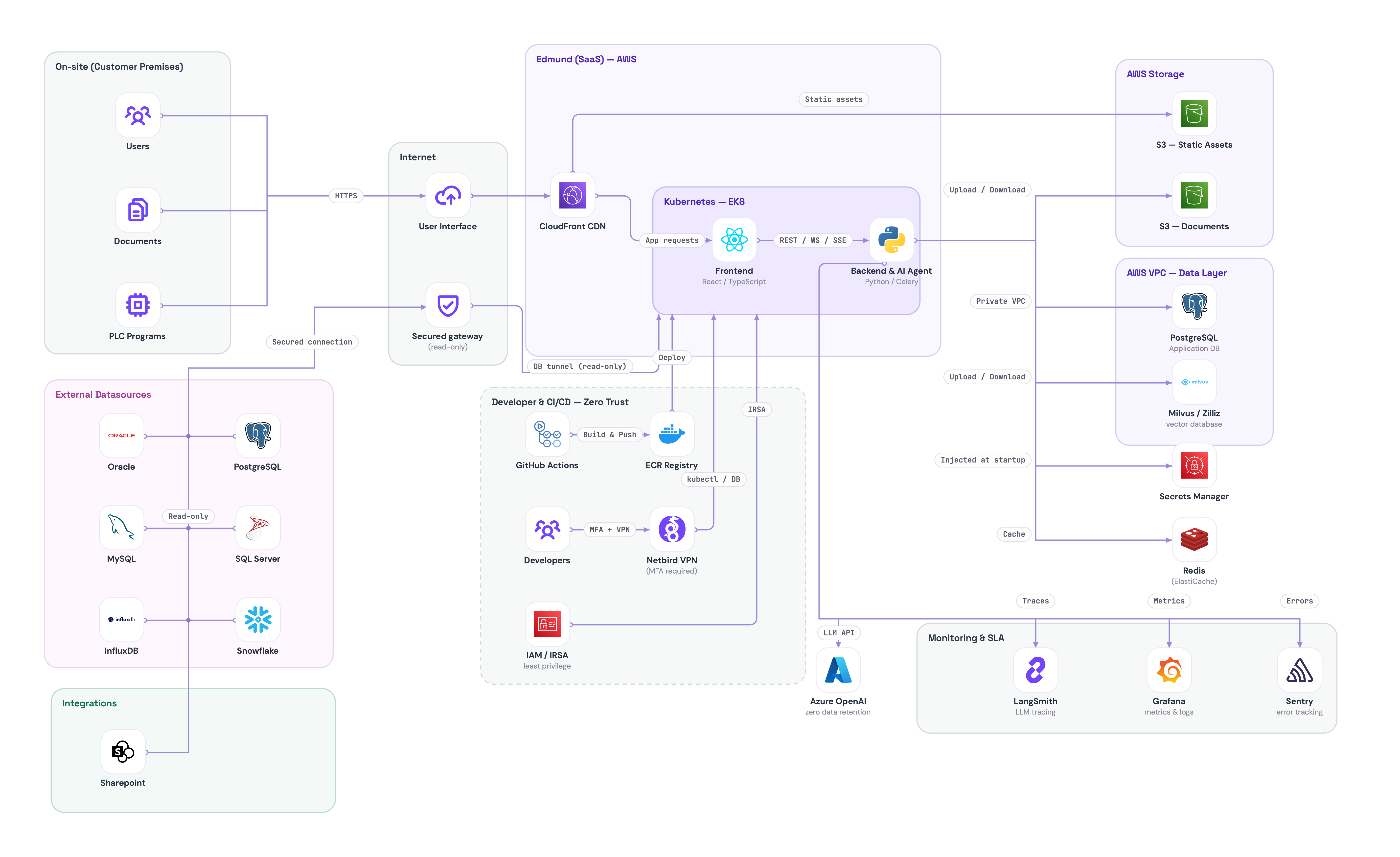
Data flow diagram
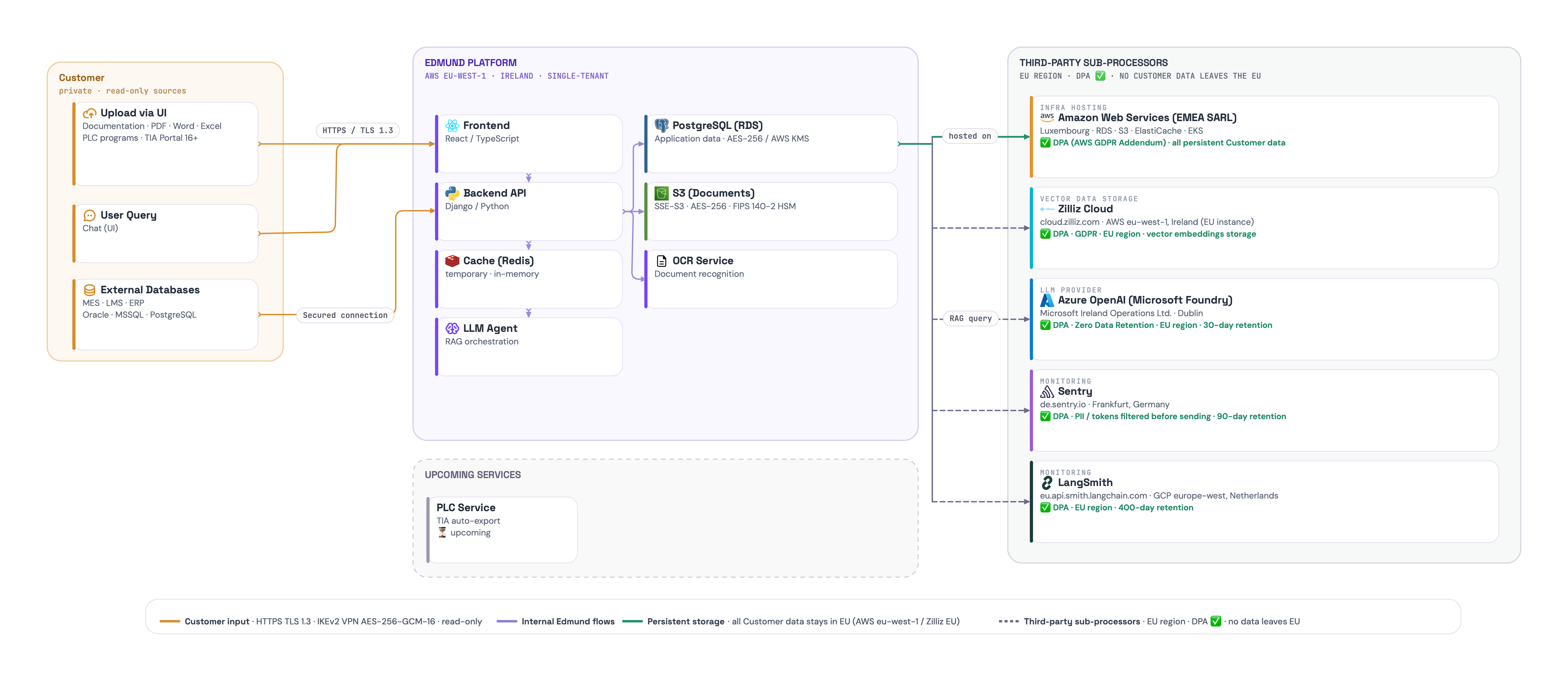
Main architecture components
Frontend: TypeScript (React framework) application communicates with REST API
Backend API: Python (Django framework)
Database: one PostgreSQL instance for application data, and Milvus Zilliz (self-hosted or cloud-hosted database) for document indexing. For on-premise installations the Milvus database can be hosted locally.
Cache: Redis
Indexing services and workers: document and data source processing
LLM Agent: Integration with Azure OpenAI API
Orchestration: Kubernetes (can be deployed in AWS, Azure, GCP or on-premise)
Monitoring and logging:
-
Sentry (app monitoring)
-
LangSmith (LLM monitoring)
-
Grafana (system metrics)
Authentication: Supported connection via MFA or SSO
All data is processed temporarily and not permanently stored outside of the customer’s database.
Component descriptions
Foundation
Base platform — The always-on foundation of Edmund. It bundles the web workers that serve the user interface and API, one indexing worker that ingests and processes documents, a pool of 6 concurrent chat agents that answer user questions, and the backend database that stores application state. This is the minimum required to run Edmund and is included in every deployment.
Scalable units
Indexing worker — Adds document-processing throughput for larger document volumes. Each worker handles roughly 30,000 pages/day or about 10 standard PLC programs/day. Add workers when ingestion backlogs grow or when onboarding many factories at once.
Chat agents — Increases how many users can interact with Edmund at the same time. Each block adds 6 concurrent chat agents; add blocks when more simultaneous conversations are expected during peak hours.
Monitoring — A small monitoring instance covering error tracking for observability of model calls. Additional units provide separate or higher-capacity monitoring coverage as the deployment grows.
Usage-based services
Custom OCR service — Converts scanned and image-based documents into machine-readable text.
Milvus (vector DB) — The self-hosted or cloud-hosted vector database that stores embeddings and powers semantic search and retrieval. Priced by the number of stored embeddings, rounded up to the next provisioned tier (see the table below).
Deployment tiers (indicative sizing and expected usage)
| Dimension | Tier 1 | Tier 2 | Tier 3 |
|---|---|---|---|
| Target scale | 1–5 factories | 5–10 factories | 30–40 factories |
| Configuration | |||
| Indexing workers | 1 | 3 (base + 2 extra) | 7 (base + 6 extra) |
| Concurrent chat agents | 6 | 12 (+1 block) | 24 (+3 blocks) |
| Monitoring instances | 1× | 2× | 5× |
| Expected usage | |||
| OCR conversions | 20,000 pages/mo | 100,000 pages/mo | 500,000 pages/mo |
| Milvus embeddings | 5 M (≈ 3 CUs, ≈ 60 GB S3) | 20 M (≈ 10 CUs, ≈ 240 GB S3) | 100 M (≈ 50 CUs, ≈ 1,200 GB S3) |
| Chat messages | 800–4,000/mo | 4,000–8,000/mo | 24,000–32,000/mo |
Connections
Everything Edmund reads arrives over one of the connections below. Each one is encrypted (HTTPS / SSL), authenticated (API token or service account) and limited to the scope it needs.
Data sources
Edmund reads a customer database through a read-only account. The engines supported are:
- Oracle
- PostgreSQL
- Microsoft SQL Server
- SAP HANA
- Snowflake
- InfluxDB
One user and one schema per connection; Specific database considerations covers what each engine needs. How the connection itself is established — in-AWS, NAT gateway with port forwarding, or Site-to-Site VPN — is covered by Connection to customer data sources.
Integrations
- SharePoint connector – read-only synchronisation of documents from one SharePoint site. Folders in a monitored document library map onto Edmund projects, so a file placed in a folder appears in the matching project without anyone uploading it by hand. Edmund never writes to SharePoint. The setup guide Working with SharePoint covers the application registration, the site grant and day-to-day operation.
- APIs – optional connection to a customer’s internal REST or GraphQL API.
Which file formats each route accepts, and the size limits that apply, are listed under Supported file formats.